
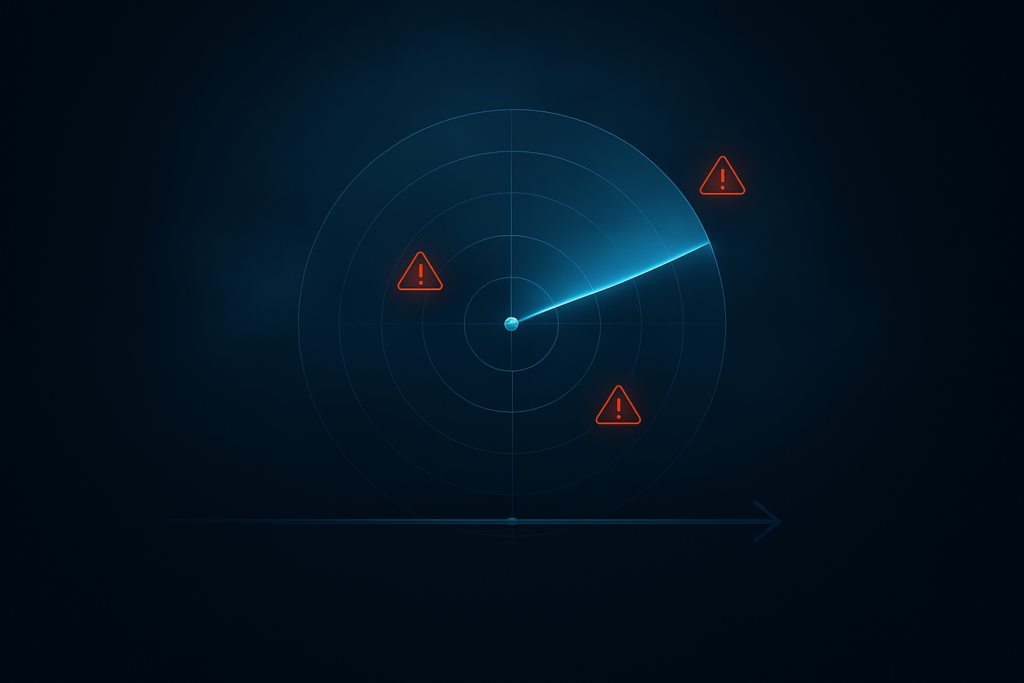
Risk Visibility — Why Hidden Moments Are More Dangerous Than Problems
Introduction
Risks rarely emerge suddenly. More often, they exist long before they become visible.
The issue is not their existence, but that at some point they cease to be visible. It is precisely at this point that decisions are made that appear logical, well-founded, and timely—while simultaneously creating the conditions for future complications.
Why the Absence of Signals Does Not Mean the Absence of Risk
In complex systems, risk rarely comes with a clear signal. It does not always manifest as a violation, a conflict, or a refusal.
More often, it disguises itself as:
- stability;
- silence from regulators;
- no questions from partners;
- formal compliance with requirements.
In such conditions, a sense of control arises. And it is the least reliable indicator of safety.
When the System Looks Stable—and Therefore Vulnerable
Stability does not always mean equilibrium. Often, it means the absence of external pressure.
As long as:
- the structure is not stress-tested;
- the decision does not enter the public domain;
- the bank, partner, or jurisdiction does not change;
- a new level of oversight does not appear,
risks can remain latent.
They do not disappear. They simply are not triggered.
Visibility as a Function of Context
Risk becomes visible not on its own, but at the moment the context changes.
The same element:
- in a familiar environment looks neutral;
- in a new context becomes problematic;
- in a sensitive environment becomes unacceptable.
That is why decisions that seemed stable can suddenly lose support without any changes to their formal substance.
Why Analytics Must Work Before Signals Appear
Analytical work is not aimed at finding violations. Its function is to expand the field of visibility.
This is not about predicting the future, but about identifying factors that may become significant after circumstances change.
Analytics works proactively:
- removes the illusion of complete clarity;
- helps reveal potential points of tension;
- keeps decisions manageable.
After signals appear, analytics no longer warns—it records consequences.
Risk as a Dynamic Variable
Risk is not a static parameter. It changes along with:
- the scale of the decision;
- the level of publicity;
- the involvement of third parties;
- the regulatory environment;
- counterparty expectations.
What was acceptable at one stage can become critical at another. Understanding this dynamic is key to preserving predictability.
Why “Nothing Is Happening” Is Not a Measure of Safety
One of the most common traps in decision-making is relying on the current absence of problems.
The phrase “nothing is happening” often means only that the system has not yet been tested for resilience.
In complex decisions, the absence of events is a state, not a guarantee.
Conclusion
Risks are not most dangerous when they are obvious. The greatest threat comes from those that are temporarily invisible.
That is why risk management begins not with reaction, but with expanding the field of vision.
Decisions made with this principle in mind do not become risk-free—but they remain manageable even in a changing environment.
Disclaimer: This material is informational and analytical in nature and does not constitute legal, financial, or investment advice. Decision-making requires an individualized analysis that takes into account the circumstances of the specific case.