
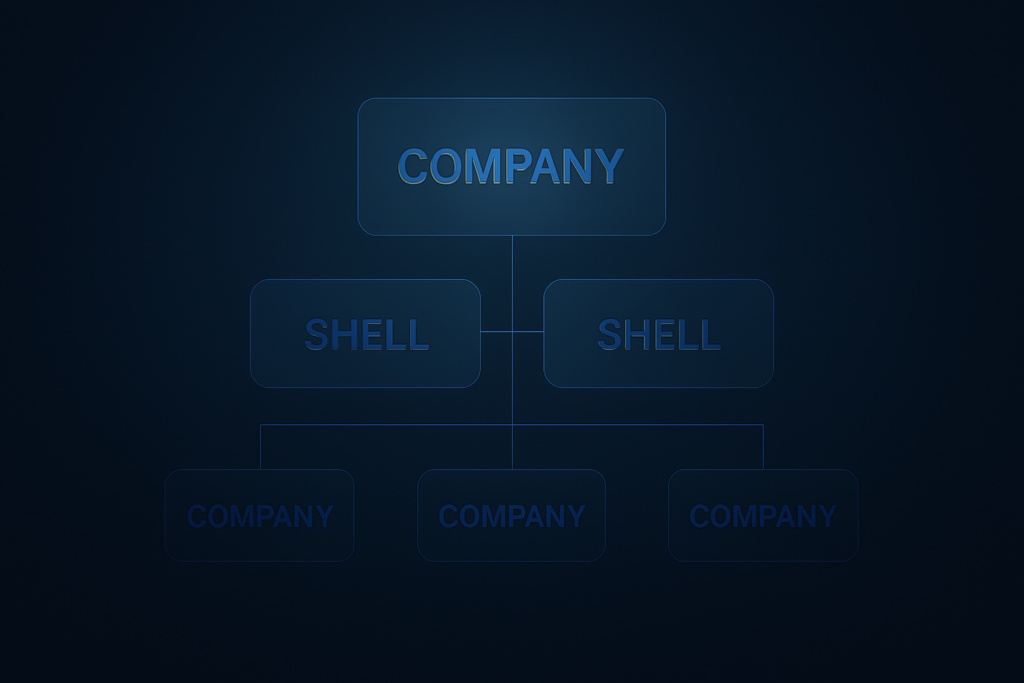
Ownership Structure & Beneficiaries — When Transparency Doesn’t Equal Control
Introduction
In complex business decisions, control rarely appears where people expect it. It almost never aligns with formal ownership charts—and even less often with what looks transparent on paper.
A company may have an understandable structure. A beneficiary may be disclosed. Documents may meet the requirements. And yet, control can still remain blurred.
It is this gap between formal ownership and actual influence that determines how stable a decision will be under pressure—when the environment changes, regulatory interest emerges, or the decision moves beyond the parties’ closed loop.
Why Ownership Structure Matters for Decisions
In business, it is not enough to know who owns. What is decisive is understanding who influences.
Ownership structure determines:
- where key decision-making is concentrated;
- how financial flows are controlled;
- who can change course at a critical moment;
- who ultimately bears responsibility in the event of conflict or crisis.
When these questions remain unanswered, decisions may look formally correct yet lose manageability over the long term.
Beneficial Owner: A Formal Definition and Practical Reality
The concept of the ultimate beneficial owner is clearly defined in legislation. At the level of legal rules, it can create a sense of certainty.
In practice, however, de facto control may be exercised:
- through multi-layer corporate structures;
- through nominee shareholders or directors;
- through contractual mechanisms that are not reflected in registries;
- through family, financial, or business ties between formally independent persons.
In such cases, formal transparency does not answer the key question: who can influence decisions when it actually matters.
Complex Structures as a Risk-Management Factor
A complex corporate structure is not, by itself, a negative factor. In many cases, it is the result of strategic planning.
However, such structures require a more attentive analytical approach, especially when:
- the structure has changed over short time intervals;
- control is distributed among related parties;
- management is carried out across multiple jurisdictions;
- there is no clear decision-making logic.
Up to a certain point, such arrangements may function stably. Problems arise not immediately, but when a decision enters a broader context and begins to be assessed by third parties.
Indirect Control and Related Parties
De facto influence rarely ends with direct equity ownership.
In practice, control is often exercised through:
- shared participation in governing bodies;
- parallel control over other companies;
- financial or operational dependence;
- historical or reputational ties among key participants.
Such ties may not have a formal expression, but they are often what determines how a business behaves in non-standard situations.
An analytical understanding of these factors does not eliminate risks—it makes them predictable.
Ownership Structure in the Context of Compliance and Sanctions
For banks, investors, and international partners, ownership structure is one of the key elements in risk assessment.
Even an indirect link to:
- sanctioned persons;
- politically exposed or politically significant figures;
- jurisdictions subject to heightened regulatory scrutiny
may not create a formal prohibition, but it can materially affect the willingness to cooperate.
In this context, what matters is not only the factual state of affairs, but also how the structure looks from the outside to actors who assess risk far more strictly than the deal parties do.
Limits of a Registry-Only Approach
State and commercial registries remain a baseline source of information. At the same time, they have natural limitations:
- data may be updated with delays;
- the history of changes is not always readable as a dynamic timeline;
- not all relationships are subject to mandatory disclosure.
As a result, a registry check often creates a sense of sufficiency that does not always correspond to the real complexity of the structure.
An Analytical Approach to Assessing Ownership Structure
An analytical assessment of ownership structure is not aimed at finding violations and does not replace legal analysis.
Its task is to form a clear understanding of:
- the logic of control;
- potential points of influence;
- the dynamics of changes over time;
- factors that may become relevant after the decision is made.
This approach helps decisions remain manageable even in a changing regulatory or reputational environment.
Conclusion
Ownership structure is not only a question of formal ownership. It is a question of control, influence, and accountability.
In complex business decisions, understanding this structure is what allows you to assess whether cooperation will remain stable over the long term.
Formal transparency creates a sense of clarity. An analytical approach helps confirm that this clarity has a real foundation.
Disclaimer: This material is for informational and analytical purposes only and does not constitute legal, financial, or investment advice. Decision-making requires an individualized analysis that takes into account the circumstances of the specific case.